

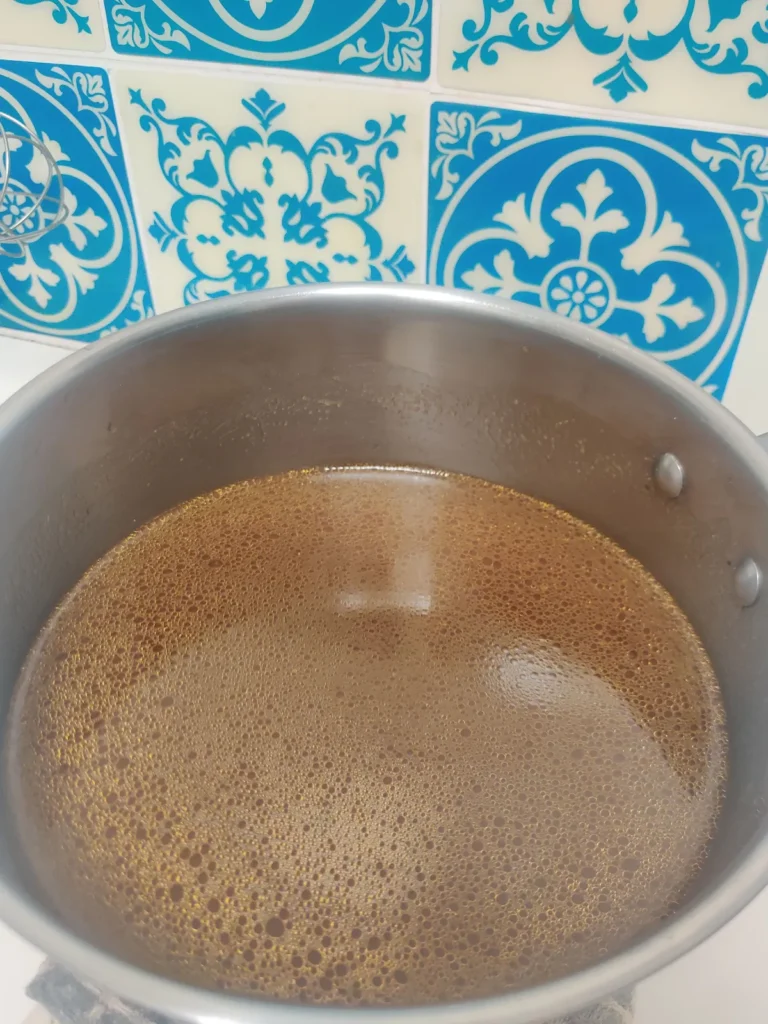
Hello again there, folks. This beef stock recipe gives you a fantastic and vastly superior stock than you'll ever get with bouillon granules. Although it does take a long time, it's rather easy to make, and the majority of the time is spent simmering and refrigerating.
Beef stock is liquid gold. It's the savoury liquid base created by simmering bones and aromatics for many hours until all flavour has been imparted into the water.
By simmering veal and beef bones and joints, the collagen is extracted and converted into gelatin. After cooling, the stock will solidify and become gelatinous.
This recipe is a bit of a mix between a simple beef stock and Escoffier's two-stage beef stock (estouffade), the latter of which should be simmered for a staggering 12-15 hours!
This makes it a great beef stock for any recipe that calls for "high-quality beef stock" and, if desired, it can be used to finish Escoffier's method of beef stock and authentic Espagnole sauce and a true demi-glace.
The ingredients used in this beef stock recipe are:

Beef stock on its own should not have any salt or seasoning beyond the typical aromatics, so it isn't exactly a meal on its own. Instead, you'll want to use this stock in any recipe that calls for beef stock, at which point you salt and season to your liking.
It's used for making further sauces and their derivatives such as:
And it is brilliant in recipes such as:
And much, much more!
Homemade beef stock shouldn't be rushed. You could simmer yours for about 4 hours at a minimum, but don't rush it - let the water absorb everything thoroughly.
Roasting the veal bones isn't just to get a nice colour: it's so you can get all those lovely drippings at the bottom of the pan! Pour in a little water and scrub all of that flavour after roasting and dump it straight into the stock pot.
You'll want to get plenty of bones and off-cuts full of collagen, so joints and bones, basically. I use veal hoofs, bones, and beef ribs for mine.
Don't go overboard with your mirepoix. Chop it into pretty big chunks, and make sure the weight ratio of mirepoix to meat/bones is about 15% or less. For a few kilograms of meat and bones, that should work out to about 1-2 carrots and onions.
After roasting the bones and placing them in the stock pot, always pour cold water to just cover the bones and then gently bring it to a boil, then right down to a gentle simmer (a little gloop gloop, not aggressive bubbling, if that makes sense).
Remember to skim the scum well, especially in the first 30 minutes of simmering the stock. There are three phases to the scum/fat:
You don't have to obsess over removing all fat from the stock at first. Just try to get most of it in the first stage (first 30 minutes of simmering), then do the rest in stage three (after refrigerating).
Unless you are trying to make consommé, your stock doesn't need to be perfectly transparent. As long as you've sieved it well, a little cloudiness is normal and harmless.
Lastly, this recipe does take quite a long time to make (and even longer if you're going to make demi-glace!), so I'd highly recommend you do as big a batch as you can. You can't refrigerate it very long, but you can freeze it and have great beef stock whenever you want.
The flavour base of many great homemade recipes often starts with a rich beef stock. This comprehensive beef stock recipe is superior to "fast" beef stocks and far better than bouillon cubes, and it's quite easy to make - although it does take a long time!
This beef stock uses roasted veal and beef bones, vegetables, and simple aromatics simmered over many hours to create a deeply savoury stock for all manner of sauces, gravies, and soups.
Coarsely chop onion and carrot and set aside. Peel garlic cloves, cut parsley stalks, and put these aside with bay leaves and thyme (or make a bouquet garni).
Cut all meat into big chunks, roughly the size of the veal/beef bones. Use your hands to coat all meat and bones with tomato puree.

Preheat oven to 220°C (428°F). Spread all bones and meat onto a baking tray and roast for about 30 minutes. Flip bones halfway through.
Add carrot and onion to the same baking tray and roast for another 5 minutes or until tips of onions start to scorch.
Remove from oven and place all bones and mirepoix into a large stock pot. Pour cold water into pot, just covering everything by a little bit.
Deglaze the baking tray with a little water and scrub with a wooden spatula to loosen the fond. Pour it into the stockpot.

Add all aromatics and then slowly bring the stock to a boil, then immediately reduce to a gentle simmer.
Simmer the stock for 6 hours. During the first 30 minutes, use a ladle to remove the scum that will appear at the surface. Repeat skimming every so often, but don't obsess over removing all fat just now.
After about 6 hours, the bones should be bare and all vegetables, meat, and collagen thoroughly broken down and bland. Pull out any large bones or chunks and discard.
Place a sieve into a separate saucepan and, with a ladle, pour any remaining chunks, letting as much liquid pass through as possible. Discard any remaining chunks.
Now strain the remainder of the stock, and repeat back and forth a few times to ensure only the stock remains.
Fill up a sink with cold water or ice and place the stockpot in the sink for a few minutes to lower the temperature. When the stock has cooled roughly to room temperature, pour contents into an airtight container and refrigerate overnight.

Remove the stock from the refrigerator. The surface should have a yellowish crust of fat on top. Use a spoon to crack into the fat and gently remove it whilst removing as little of the gelatinous stock underneath as possible.
Either place the stock back in the refrigerator to use later, or ladle out as much of the gelatin stock as needed and reheat on the hob if using now. Keep frozen until needed.
Howdy and greetings from Portugal :) I hope you found this recipe to be inspiring and - most importantly - tasty! If you enjoyed it, don't hesitate to tell me what you thought of it.