

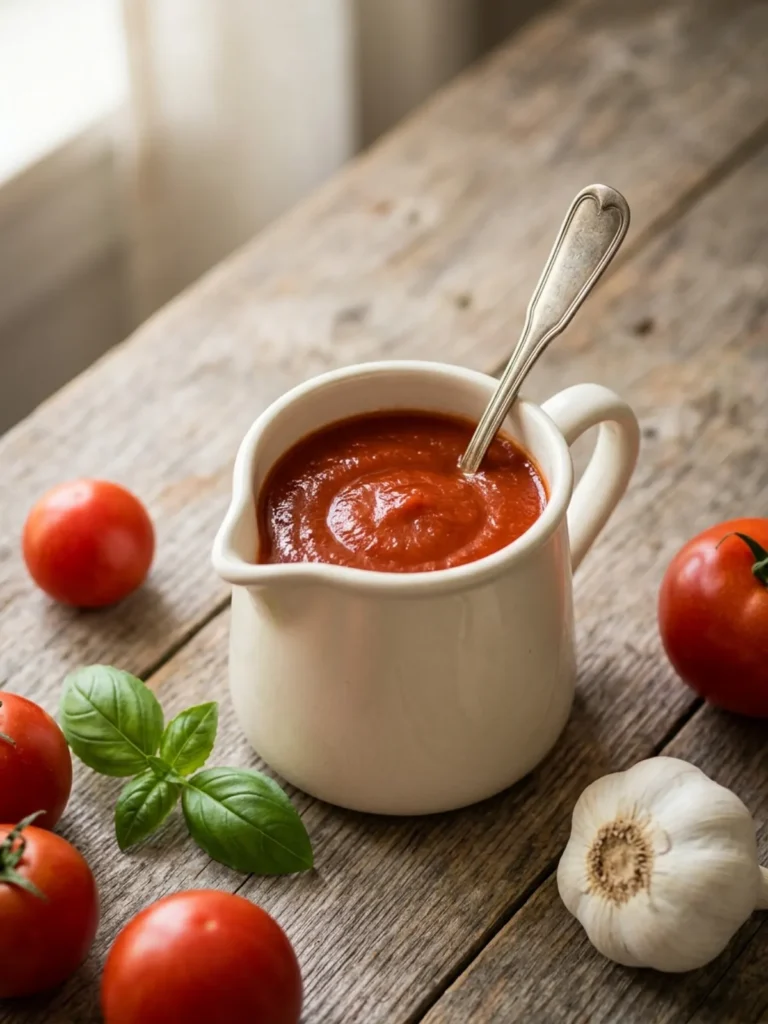
Hello again there, folks. You've probably had your fair share of tomato sauce, but sauce tomate might just surprise you.
Sauce tomate (or sauce tomat) is one of the five classic French mother sauces. It is quite different from many tomato sauces which you might have had with pasta, for example.
It was first classified and established by August Escoffier in his seminal work, Le guide culinaire, as a mother sauce.
Whereas "tomato sauce" is often used as a catch-all for everything from marinara to Bolognese sauce, sauce tomate is a specific French mother sauce using traditional techniques and building a base that can be turned into all sorts of finished tomato sauces.
This sauce is quite rare to see used as-is, but rather it's more common to build delicious tomato sauces using it as a base.
That being said, several modern tomato sauce recipes make so many adjustments to technique and ingredients that they are essentially different, but some remain quite close to Escoffier's original recipe.
Sauce tomate is built on a roux and contains tomatoes, stock, pork belly, a simple mirepoix, and a few herbs.
Sauce tomate is actually quite rare to see served on its own. It can be poured over gratins or over eggs, and it's quite good as-is, but most recipes use a sauce tomate with some modifications.
Some of sauce tomate's derivative sauces include:
N.B. Several of these sauces are prepared today using vastly different techniques to the original sauce tomate, so at most one can say they are inspired by Escoffier - at least in their modern iterations.
The number one "secret ingredient" for homemade sauce tomate is to give it time. As tomatoes reduce with stock, the concentration of flavour intensifies more and more.
You can simmer the entire sauce on the hob rather than in the oven, if you like, but the key is to give it time.
Your tomatoes can be ripe and crushed by hand, or tinned crushed tomatoes will work just as well. Just try to use a variety that is low-acidity.
There is no avoiding acidity in tomatoes, but a concentrated sauce should not be overwhelmingly acidic. A little sugar added at the end can round out an acidic sauce.
You can completely omit the roux, as many modern sauce tomate recipes do. Without it as a thickener, however, you might have to simmer the sauce for even longer.
For vegetarians, swap the stock with vegetable stock and omit the pork belly (use another tablespoon of butter to compensate for the fat).
A traditional French sauce tomate works as a fantastic all-around base for making your own tomato sauce. Built on a roux with salted pork belly, mirepoix, and a mix of crushed tomatoes and white stock simmered over 1.5 hours then strained. Build your own tomato sauce with this classic recipe.
Cut pork belly into strips or cubes. Crush tomatoes. Peel and cut the onions and carrots to a big mirepoix cut of about 1.5-2 cm. Set ingredients aside.
In a large pot or saucepan, melt 2 tbsp butter over medium heat. Add the pork belly and cook until fat renders, about 3 minutes, stirring occasionally.
Add carrots, onions, bay leaf, and thyme, stirring occasionally until onions turn translucent, or about 5 minutes.
Add 3 tbsp flour and stir continuously for about 5 minutes or until flour is cooked out and has begun to turn brown.
Add all tomatoes and stock, stirring to incorporate the ingredients together. Bring to a boil, then remove from heat.
In a preheated oven set to 180°C, add the entire pot and cook for about 90 minutes. The vegetables should be completely soft and the sauce should reduce and thicken by quite a bit.
Remove from heat, remove bay leaf and thyme sprig, then strain through a sieve into a large, clean bowl or saucepan. Repeat straining, if desired, to achieve a smoother consistency. Serve immediately or let rest for 15 minutes before transferring to a container to refrigerate.
Howdy and greetings from Portugal :) I hope you found this recipe to be inspiring and - most importantly - tasty! If you enjoyed it, don't hesitate to tell me what you thought of it.