

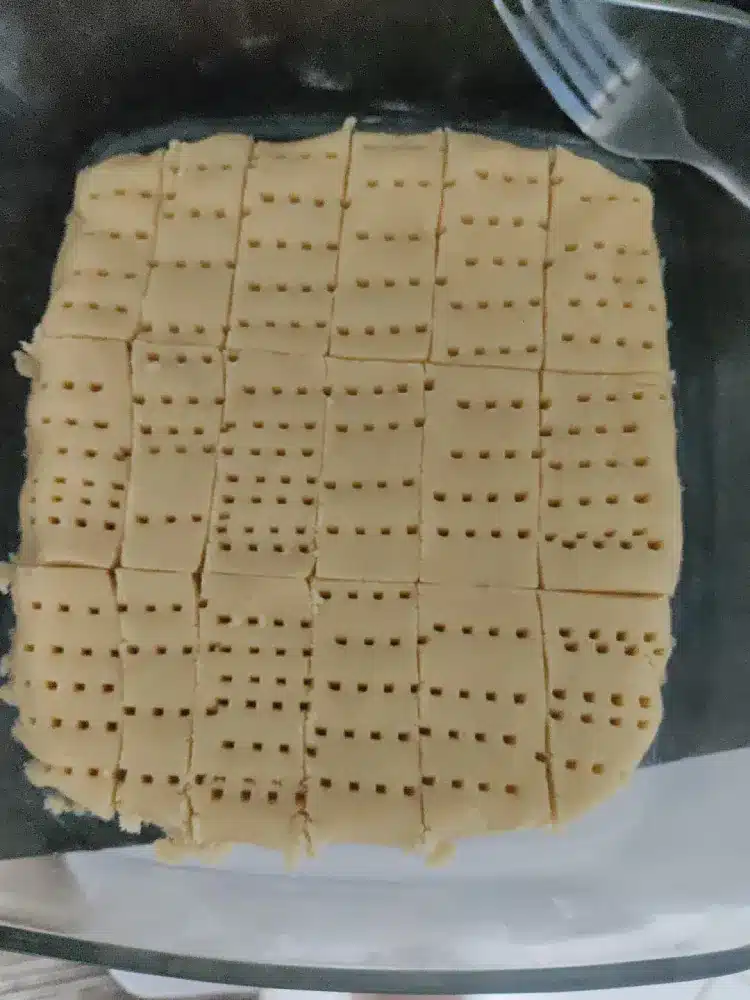
Hello again there, folks. Scottish shortbread fingers are a beloved treat in Scotland, the UK, and worldwide, and this recipe will help you bake them just right.
Scottish shortbread fingers are biscuits with a buttery flavour and crumbly texture made with only three simple ingredients. They can be cut any way you like, but they're traditionally cut into long rectangular fingers.
Shortbread itself is centuries old and originated in Scotland, and it refers to the crumbly consistency given by the generous use of butter. In mediaeval Scotland, butter would have been quite expensive, so it was most likely enjoyed by the nobility for Christmas, Hogmanay, and weddings.
Today, shortbread fingers are quite famous worldwide, especially from major brands such as Walkers.
This simple recipe follows the traditional 3-2-1 ratio of flour-butter-sugar for shortbread. There is some leeway and it doesn't need to be a perfect 3-2-1 ratio, but keeping it close to that ratio ensures a crumbly texture and buttery flavour.
You can enjoy your Scottish shortbread fingers any way you like, and they're a perfect little snack for teatime or for dessert.
Coffee, tea, or your beverage of choice pairs well, but keep in mind that they don't dip too well! The crumbly texture will probably fall apart rather quickly in a hot cuppa.
You don't need anything else, but if you want, you can spread some nice jam or preserve on top. Just enjoy as-is, either fresh or the next day when the buttery flavour really has time to develop.
The number one trick to getting Scottish shortbread right is to stick to the 3-2-1 ratio of flour-butter-sugar as best you can. Weigh/measure your quantities and don't stray too far from that ratio to get the best texture.
Next, use a room temperature butter that's soft enough for you to leave an impression with your finger but not greasy or melted. Your butter should be a good European butter, which tends to have higher fat content than many other butters.
If you cannot find caster sugar in your supermarket, simply take granulated sugar and pulse it in a food processor until it's fine/superfine in texture. That's essentially caster sugar.
Don't overwork the butter into the sugar to the point that it creams up or fluffs up too much. Work it in gently with a spoon or spatula.
When adding the flour, you should do it with your bare (washed) hands, gently clumping it together. The texture should feel like breadcrumbs, clumpy and dry at first, but without any dry flour or wet butter left behind by the time you're done.
Lastly, generously dock (poke holes with a fork) all over the surface of the shortbread before baking. This helps steam escape, ensures an even bake, and helps you avoid cracks or puffing out too much. The holes will sometimes disappear after it's baked, but don't worry, they've done their job.
This iconic Scottish teatime favourite features only three simple ingredients in a simple, time-tested ratio of three parts flour to two parts butter and one part sugar. A simple baked dough that creates a lovely shortbread with a deep butter flavour and crumbly texture.
In a large bowl, add all sugar. Add all softened butter and combine with a spoon or spatula, gently working the butter into the sugar until smooth and slightly creamy.
Add all flour to the bowl. Wash your hands, then begin gently clumping the shortbread dough together until combined. The mixture will start off feeling dry, and eventually it should be smooth without any dry flour or wet butter left behind.
Add the dough to a 20x20cm baking tray. Use your hands to smooth it out across the surface and in the corners. Use the bottom of a spoon to smooth it out more evenly.
Using a fork, begin docking through the dough about halfway, in rows, across the entire surface.
Preheat the oven to 160°C. Bake the shortbread for approximately 30 minutes, or until the edges start to brown but the top is still pale. If the centre begins to brown, remove immediately.
Remove from oven and sprinkle the surface with caster sugar. Let rest for at least 15 minutes. Cut into the desired shape while still warm.
Howdy and greetings from Portugal :) I hope you found this recipe to be inspiring and - most importantly - tasty! If you enjoyed it, don't hesitate to tell me what you thought of it.