
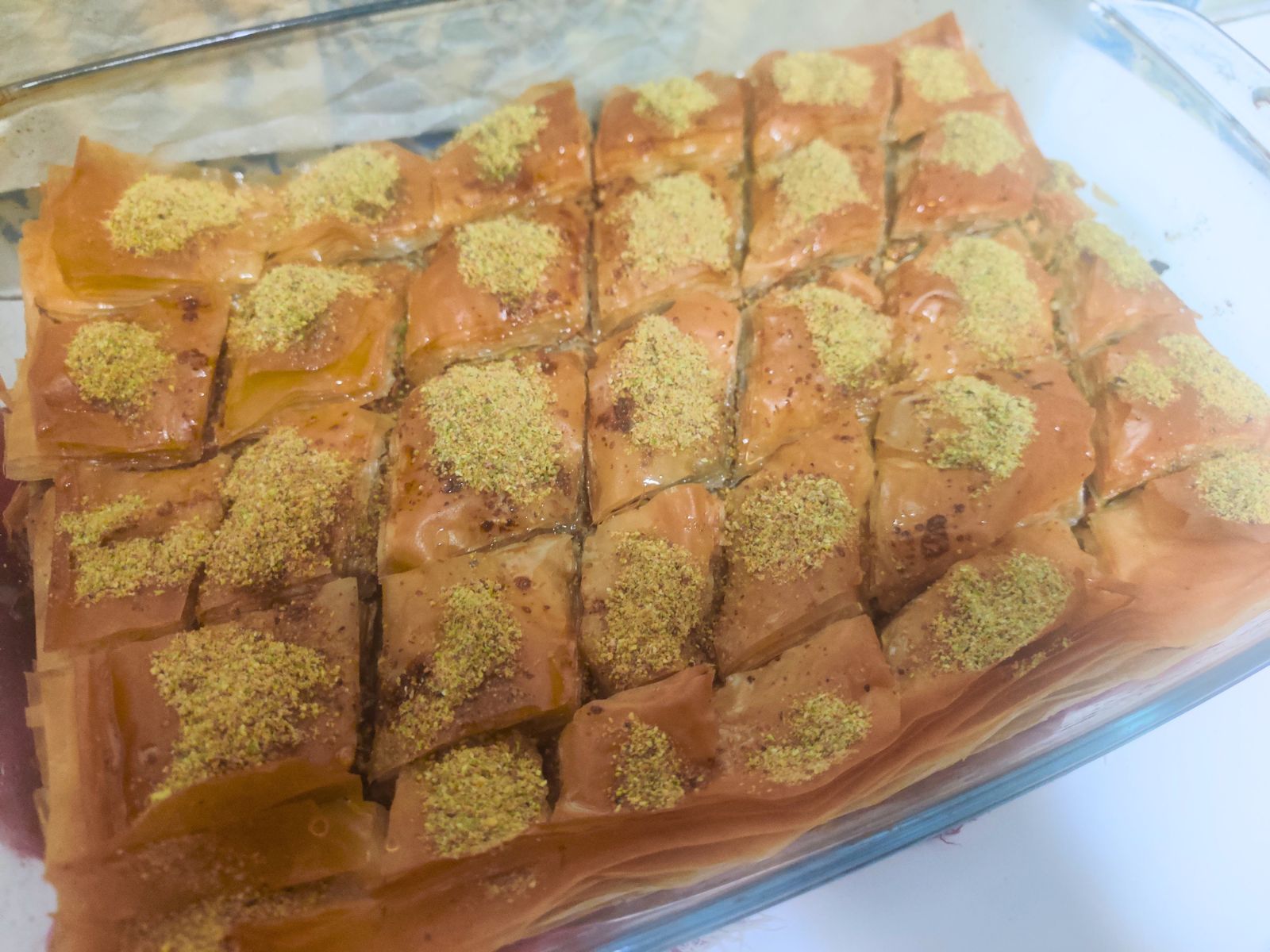

Greek baklava (Μπακλαβάς) is a classic dessert, and it’s actually a lot easier than you might expect! Enjoy my take on this wonderfully sweet and flaky Greek dessert for yourself and your family.
Why Greek baklava is not as hard to make as it seems
In baking, some pastries and desserts are quite complicated – baklava is not one of those dishes. It’s actually quite hard to get it wrong. All it requires is a little patience, layering out the filo dough a couple of sheets at a time, buttering them, and placing the filling.
Not only is baklava easy to make, but it’s also pretty versatile and you can fill it with just about any blend of nuts and spices you like.



This recipe was inspired by both the traditional Greek method of preparing Baklava as well as Refika’s Kitchen: Famous Turkish Baklava, so it’s not 100% authentic to one country’s cuisine or the other but rather a nice little fusion.
An authentic Greek baklava will usually have either walnuts or almonds, depending if it’s from the north or south, but it’ll often have a blend of nuts. It also uses cinnamon, both in the nut filling and in the honey-based syrup.
An authentic Turkish baklava will often just use pistachio or a blend of nuts, and the syrup tends to be more of a sugar-based syrup.
My recipe uses both pistachios and walnuts, but you have complete freedom to choose your nuts for your own.
What’s needed for a baklava?
Baklava can be broken into three separate parts: the pastry, the filling, and the syrup. Here’s what you’ll usually find in a traditional baklava and what I’ve put in mine:
- Filo Pastry: absolutely essential and the reason why baklava becomes flaky and crispy when baked. You can make your own filo dough, but it’s perfectly fine to use shop-bought filo pastry. My shop sells them in 250g packets of 8 each. Try and get 30-40 sheets total.
- Butter: use unsalted butter, because we’re going to use a lot of butter. I used a whole tub (250g) and melted it in a small roasting tin over medium-low heat. We need to brush every two sheets of filo with butter, but don’t soak the sheets – just a light brushing is all that’s needed.
- Nuts: use anything you like, either alone or mixed with other nuts. Commonly you’ll find pistachio, walnut, and almond filling for baklava, but pecans, hazelnuts, or even sesame or raisins may be used. To chop them up, use a food processor and aim for a variety of chunk sizes. I kept a handful of pistachios for the end and ground them up very finely to use as garnish.
- Syrup: Greek baklava uses a honey syrup; Turkish uses sugar syrup. Either works. Greek honey syrup is usually infused with cinnamon and lemon juice and zest, but orange is a nice substitute, too.
- Seasoning: the only thing I’d add to the nut mix is a couple teaspoons of ground cinnamon, but you can add things like ground cloves for more of a warm, Christmas flavour if you like.
Tips & tricks for a flaky (not soggy) baklava
While I did say that baklava is pretty difficult to mess up, there are still a few common mistakes I see people making that give them a less-than-impressive result.
Firstly, don’t overdo the butter between your layers. Soaked filo dough can lead to a soggy baklava. Use soft brush strokes to lightly touch each sheet, but also to avoid ripping the delicate filo.
No matter how you layer your baklava, try to always make the bottom and top rather thick, e.g. 6 layers without filling on the bottom, 6 on top. This helps to prevent it from crumbling and gives it some body.
Always pour cold syrup onto a hot baklava out of the oven, or hot syrup onto a cold baklava kept in the refrigerator.
If your filo sheets are larger than the oven dish (which is likely), cut them all to size and use the leftovers hidden in between the top and bottom layers.
Alternatively, keep them hanging over the side of the tray then fold them over, two at a time, butter, and continue placing layers on top.
Slice your baklava 3-4 times lengthwise, then start slicing diagonally to get trapezoidal or diamond shapes. You can slice it into squares, rectangles, or triangles too if you like.
✅ Pro Tip: slice the baklava almost (but not all the way) to the bottom before placing in the oven. This makes it easier to serve and helps prevent the syrup from sogging up the bottom.

Description
This Greek & Turkish-inspired baklava features layered, buttered filo dough with spiced walnuts and pistachios, baked until flaky and golden, then covered in a fragrant honey syrup. A favourite in Greece and beyond for Lent, holidays, or simply to pair with a nice strong coffee.
Ingredients
Pastry
Filling
Syrup
Instructions
Mise en Place
-
Add nuts, 2 tsp cinnamon, and a pinch of salt to a food processor and pulse into small chunks. Remove 2/3 and pulse remaining 1/3 into a finer consistency. Set a handful of the finest dust for garnish at end, put remainder in a bowl and set aside.
-
Melt butter and set aside.
-
Open all filo pastry packets and use a knife to cut to size of a glass oven dish (e.g. 35 x 23 cm). Cover with a damp cloth.
Layering
-
Brush butter along the bottom and sides of the glass baking dish. Place two sheets of filo, then brush lightly with butter. Repeat this process until 8 sheets of filo have been layered. This is the "bottom" of the baklava.
-
Add about 1/5 of the nut filling and spread evenly across the surface. Place two filo sheets on top, then butter. Place two more filo sheets on top, then butter.
-
Repeat the previous step until all of the nut filling has been used up. To summarise where you should be at: 8 bottom layers + filling + 4 layers + filling + 4 layers + filling + 4 layers + filling + 4 layers + filling. This is the "middle" of the baklava.
-
Place the remaining 9 layers of filo dough, again buttering between every 2 sheets. This is the "top" of the baklava. To recap, you should have: 8 layers (bottom) + 16 layers (middle with filling) + 9 layers (top) = 33 layers.
-
Using a sharp knife, slice the baklava into the desired shape, cutting almost to the bottom but not 100% through.
-
Place in a preheated oven at 180°C (350°F) for about 40 minutes or until golden.
Syrup
-
In a small pot, add the water, honey, sugar, cinnamon stick, lemon juice, and lemon zest. Bring to a boil, then reduce to a simmer for about 20 minutes or until sugar is completely melted. Remove from heat.
Serving
-
Remove baklava from oven and pour syrup (if cooled) on top, evenly so that it covers the top and seeps into the sides. Allow to rest for about 2 hours.
If baklava has already cooled, heat up the syrup, then pour on top. Allow to rest then serve.
Optionally, garnish the top of every slice with a pinch of the finest remaining nut mix.
Note
- Storage: can be kept in a cool, dark place at room temperature for about 1 weeks, or in the refrigerator for about 2-3 weeks but it will lose some of its texture.
- Nuts: mix and match or just do one type of nut if you desire. Popular choices for Turkish baklava are pistachios, Greek baklava usually has almonds (south) or walnuts (north). Pecans, hazelnuts, raisins or sesame seeds can also be used.
- Filo layers: you don't have to use 33 layers of filo dough. 40 layers or even fewer than 33 should still give you a good, flaky pastry. Readjust the layering to even out the spread of the nut filling to your liking.
- Pairings: a good piece of baklava goes well with tea or coffee, and it can be eaten as a daytime snack or dessert.


